Jewish Terms
This website uses many terms relating to the Jewish Funeral traditions. This section provides help in understanding these terms:
ANINUT
The period from the time of death to the burial is known as aninut. During this time, the family is left alone by the Community so they can grieve privately and make preparations for the funeral. They are exempt from all positive commandments (“thou shalt’s”).
CHANUKIAH
The Chanukiah menorah performs a central role in the holiday of Hannukah. Eight of the nine branches hold lights (candles or oil lamps) that symbolize the eight nights of the holiday. On each night, one more candle is lit than on the previous night, until on the final night all eight branches are ignited. The ninth branch holds a candle, called the shamash ("helper" or "servant"), which is used to light the other eight.
CHEVRA KADDISHA
Chevra Kadisha societies date back for thousands of years. They prepare the deceased for interment by performing a ritual purification known as the Taharah. Doing kind deeds (mitzvahs) for someone who has just died is done with the knowledge that the kindness cannot be repaid by that person. This kindness has long been regarded as the ultimate act of unselfishness.
CHESED SHEL EMES
Chesed Shel Emes is an act of loving kindness.
COHANIM
Cohanim or Kohanim is used in reference to the Aaronic priesthood, also called Aaronites or Aaronides. Levitical priests or Cohanim are traditionally believed and required to be of direct patrilineal descent from the biblical Aaron, brother of Moses. Traditionally, Cohanim cannot attend a funeral by being under the same roof as a funeral for consideration of their purity.
Benjamin’s has a separate structure with ample viewing and listening access to the Chapel allowing Cohanim to witness the funeral without being visible to the remaining community. This unique facility was the first of its kind in North America.
HAVDALAH
The religious ceremony or formal prayer marking the end of the Sabbath (Shabbat). It involves lighting a special havdalah candle with several wicks, blessing a cup of wine and smelling sweet spices. Shabbat ends on Saturday night after the appearance of three stars in the sky.
JEWISH PLURALISM
Jewish pluralism means being inclusive and tolerant to the range of Jewish traditions from various cultures around the world.
Toronto is home to one of the strongest, most observant and most diverse Jewish communities in North America. Unlike the immigration pattern in many US cities, the Toronto community did not arrive en masse from the shtetl 100 years ago. There have been many waves of immigration, each bringing its own distinctive flavour. In the multi-cultural nation that is Canada, each new wave has found a place along the wide spectrum of Jewish observance.
Toronto's Jewish population continues to grow strongly with the newest members of our community arriving from Morocco, Russia, South Africa, Israel, and even from Montreal.
Equal to one another.
Our community reflects this wide range of cultural observance, and it reflects an equally wide range of religious interpretation and observance, from the Left to the Right, through Traditional, Conservative, Liberal, Reconstructionist, and all the nuances within them. There are many ways for Toronto Jews to meet their religious needs.
Within this framework, we believe all Jews have the right to follow their beliefs as prescribed by their tradition. We believe that each of these different traditions stands equal to one other on the wide spectrum of Jewish observance. The beliefs and practices of each tradition represent legitimate interpretations of Jewish Law, and no group has the authority or right to judge the validity of the interpretation of another group. We call this philosophy Jewish Pluralism.
We are committed to this concept of Jewish Pluralism. For generations we have dedicated ourselves to providing for and protecting the rights of all those in our community who turn to us in their time of need. Benjamin's is unique in Toronto for its understanding and support of this pluralistic view of the Jewish community and as such, is the only funeral chapel dedicated to meeting these varied needs with dignity, respect, and honour. It is our sacred trust.
KADDISH
Kaddish means 'sanctification' or 'holy' and is a specific prayer. Of the five variations of the Kaddish, the best known is the Mourner's Kaddish. The prayer never mentions death or dying, but instead proclaims the greatness of G*d.
KAVOD HA-MET
The principle of kavod ha-met, respect for the dead, is strictly honoured in all funeral rituals. It is of the utmost importance to treat the body with respect and care from the time of death until the burial is completed.
KIPPAH (Plural KIPPOT), YARMULKE, OR SKULL CAP
The small skull cap worn by all Jewish men particularly during prayer as a sign of humility and respect.
KRIAH
Kriah or tearing a garment in grief is an ancient practice of tearing clothes as a tangible expression of grief and anger in the face of death. Kriah is usually done at the funeral home before the funeral service begins. If a black ribbon is used instead of cutting clothing, the funeral director provides it. Kriah is always performed standing. The act of standing shows strength at a time of grief. A cut is made on the left side of the clothing for parents—over the heart—and on the right side for all other relatives. The torn garment or ribbon is worn during the seven days of Shiva (but not on Shabbat and Holy Days).
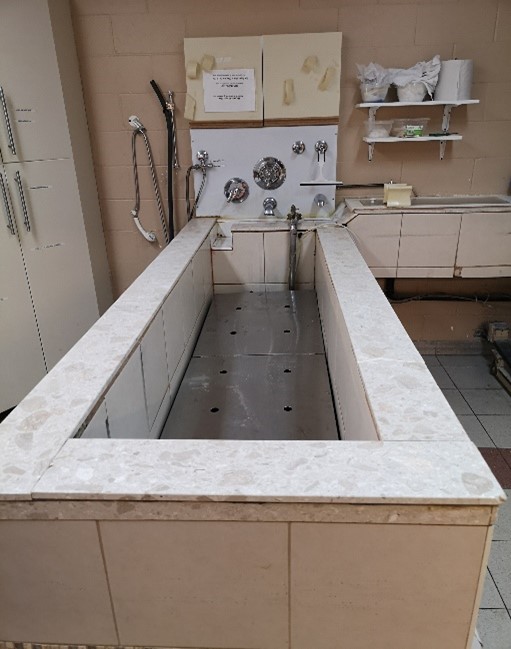
MIKVAH
The cleansing bath used for the purpose of achieving ritual purity, most impurity can be purified through immersion in a natural collection of sweet water. The Mikvah has no drain in order to protect the purity of the sweet water. Benjamin’s collects rainfall as a source for this sweet water.
MINYAN
A Minyan or quorum of ten men (or in some synagogues, men and women) over the age of 13 that is required for traditional Jewish public worship.
MITZVAH (Plural MITZVOT)
A good deed done from religious duty; one of the 613 Mitzvot, or commandments, of Judaism.
SHLOSHIM
Shloshim literally means thirty; it is the month of mourning following the funeral. After the seven days of Shiva mourners customarily resume their regular activities, but refrain from attending parties, listening to live music or other forms of public entertainment. Some mourners continue to say kaddish daily particularly if they are mourning a spouse, parent or sibling.
SHOFAR
The shofar is an ancient musical horn typically made of a ram's horn, used for Jewish religious purposes. The shofar is blown in synagogue services on Rosh Hashanah and at the end of Yom Kippur; it is also blown every weekday morning in the month of Elul running up to Rosh Hashanah. Shofars are in a variety of sizes and shapes, depending on the choice of animal and level of finish.
SHOMER
The Jewish tradition is that no body should ever be left unattended because the soul has not left it until burial. A Shomer (guardian of the dead) constantly attend a body. Your loved one will always be accompanied and surrounded by the poetry and protection of psalms.
SHMEERA
Shmeera is the act of watching or guarding the body from the time of death until the time of burial. It is an ancient custom for the body to be constantly attended by a guard or Shomer. Shmeera is usually performed in shifts by men who all sit and recite psalms.
TAHARA
The ritual cleansing of the body through immersion in a mikvah. Taharahs are performed for men by men and for women by women.
TACHRICHIM
The traditional simple burial clothes or shroud. The Jewish burial shroud consists of seven garments of natural unbleached linen, hand-sewn and unchanged since Biblical times. They are made without fasteners and without pockets. Some men are also wrapped in their tallit (prayer shawl).
TALLIT
A tallit is a fringed garment worn as a prayer shawl by religious Jews. The tallit has special twined and knotted fringes known as tzitzit attached to its four corners. The cloth part is known as the beged (literally ‘garment’) and is usually made from wool or cotton, although silk is sometimes used.
TORAH
The Torah is the compilation of the first five books of the Hebrew Bible, namely the books of Genesis, Exodus, Leviticus, Numbers and Deuteronomy. In that sense, Torah means the same as Pentateuch or the Five Books of Moses. It is also known in the Jewish tradition as the ‘Written Torah.’ It takes the form of a Torah scroll.
TZEDAKAH
A righteous act, usually referring to an act of charity, such as giving.
YAHRZEIT
Yahrzeit refers to the anniversary, according to the Hebrew calendar, of the day of death of a loved one. The Yahrzeit is observed by lighting a candle to honour the memory of a loved one. It is common to visit the grave, recite Kaddish and perform a righteous act, Tzedakah, such as giving to charity. When visiting the grave, one may leave stones at the gravesite in recognition of the visit. To remember your loved one’s Yahrzeit date, we offer email reminders which you can subscribe to.
YIZKOR
Is a public observance to remember and honour those that have died. This occurs on certain Holy Days through a memorial service. Yizkor occurs four times each year. The dead are again honoured by the lighting of a candle, visiting the grave, reciting the Kaddish and giving to a charity. We offer a list of Yizkor dates to help you schedule your time.
Please note that spellings you see may vary for some terms as they are transliterated into English